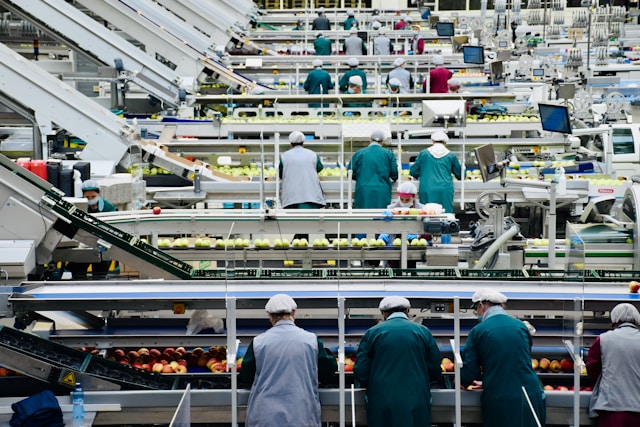
Photo by Arno Senoner on Unsplash
ExecutiveChronicles | The Cold, the Knives, the Careers: Workforce Development in Seafood Manufacturing | The first thing you notice on a processing floor isn’t the machinery, it’s the rhythm. Hairnets and cut-resistant gloves. A quick pre-shift stretch. Forklifts chirping at crosswalks. The clean, antiseptic brightness of a place where “food” and “factory” have to mean the same thing, every hour of every shift.
Seafood manufacturing is a hard industry to staff in any economy. It’s cold. It’s physical. It’s full of sharp edges, literally and operationally. And it’s unforgiving: if training slips, quality slips; if safety culture weakens, injuries rise; if careers feel capped, turnover becomes the business model.
That’s why workforce development has quietly become one of the most consequential “sustainability” stories inside companies like Pacific Seafood, an employer that says it has more than 3,000 team members across its footprint and sells products globally. The question isn’t whether they train. It’s whether training is designed as a system: one that builds skills fast, makes safety everyone’s job, and gives people a reason to stay.
The Backdrop: A Tight Labor Market + a High-Risk Subsector
Hiring is competitive across manufacturing, and the numbers show it. In November 2025, U.S. manufacturing still had about 403,000 job openings (a 3.1% openings rate). For employers that rely on hourly production roles, the competition doesn’t stop at the plant gate; transportation and warehousing (critical for cold chain) posted about 325,000 job openings in the same month.
Zoom out further, and the long-range pressure looks even more structural. A Deloitte/Manufacturing Institute workforce study highlights the possibility that up to 1.9 million manufacturing jobs could remain unfilled by 2033, driven by both skills gaps and applicant shortages.
Now layer in safety. Seafood processing sits inside an injury-prone corner of the food system. The Bureau of Labor Statistics reports 5.7 total recordable cases per 100 full-time workers for “Seafood product preparation and packaging” (NAICS 3117) in 2023, well above manufacturing overall (2.8) and private industry (2.4). These aren’t abstract figures; they’re the statistical shadow of knives, repetitive motion, slippery floors, and the pace demands of perishability.
So any serious workforce strategy in seafood has to do three things at once:
- build competence quickly,
- reduce injury risk, and
- create a credible path from “new hire” to “I can build a life here.”
Pacific Seafood’s Approach: Build an Internal “Learning Supply Chain”
Pacific Seafood’s 2024 Corporate Social Responsibility report reads like an argument that training is infrastructure, not a perk. The company describes a revamped, mobile-accessible learning platform, Pacific Seafood University (PSU), as the home for “over 1,000 self-service training courses”, plus performance reviews and annual goals.
The number that caught my eye is unusually concrete: 10,102 hours of training in 2024. That’s not a marketing adjective (“robust,” “comprehensive”); it’s a measurable output. And it signals something important about how the company is framing the problem: if turnover and skills gaps are chronic, then training can’t be occasional. It has to be continuous, accessible, and tailored to frontline reality, especially in multilingual, multi-site operations.
Pacific also emphasizes training as a promotion engine, not just a compliance requirement. The report describes Team Blue, a development program aimed at frontline team members, explicitly tied to “promote from within,” and says the program “nearly tripled in 2024.” That phrasing matters. In labor-tight markets, internal mobility is one of the few levers that can beat wage-only competition because it changes the trajectory, not just the paycheck.
The “Middle Layer” Problem: Teaching Supervisors to Lead and Keep People Safe
In manufacturing, supervisors are the hinge point. They translate policy into reality: whether a new hire speaks up about a near miss, whether the line stops when something looks off, whether safety is enforced consistently or selectively.
Pacific’s report highlights two management-level pathways:
- Diamond Week (launched in 2024): a program for newly promoted or hired managers, bringing them to headquarters for a “deep dive” into company culture, including discussions of “servant leadership” and field trips to processing and distribution sites.
- Supervisory Basics: a course centered on communication, conflict resolution, and time management for people in supervisory roles.
This combination of culture immersion and practical supervisory skills tracks with what broader manufacturing research has been warning: the skills gap isn’t only technical. The 2024 Deloitte/Manufacturing Institute findings emphasize that manufacturers increasingly need a blend of technical, digital, and soft skills, and that shortages show up as much in people leadership as in machine maintenance.
Safety Culture: Data, Reporting, and the Unglamorous Work of Prevention
If you want to understand whether a safety culture is real, watch what an organization measures and what it encourages people to admit.
In 2024, Pacific says it launched a new dashboard allowing leadership and EHS teams to monitor injury reporting as it occurs, enabling targeted training and preventative measures based on trends. The report also states that since 2021, the company has seen a “drastic drop” in on-the-job injuries and “remains below the industry average,” while also promoting a system that encourages team members to report injuries.
There’s an important tension embedded in that last clause. Companies often say “safety first,” but workers sometimes hear: “Don’t mess up our numbers.” The credibility test is whether reporting is protected and normalized.
On that point, OSHA’s guidance on worker participation in safety programs is blunt: employers should ensure systems protect workers from retaliation for reporting injuries, illnesses, and hazards, and should make participation possible regardless of language or education level. Pacific’s emphasis on injury reporting in real time, while training topics that include near-miss and incident reporting, suggests they’re trying to build the kind of feedback loop OSHA describes.
And the report gets specific about what “annual safety training” means on the ground, everything from chemical hazards and machine guards to confined spaces, PPE, ergonomics, lockout awareness, and slip/trip/fall prevention. That’s not glamorous, but it’s what reduces the 5.7-per-100 injury reality BLS reports for the seafood processing subsector.
Pacific also describes a gap analysis tracker used by divisional EHS managers to provide site-specific feedback and focus on root causes and preventative actions. It notes tightened protocols like mandatory chemical audits, expanded biweekly EHS trainings, and workplace violence training for several locations. This is the safety story most consumers never see: prevention is won in checklists, refreshers, and uncomfortable conversations, not slogans.
Career Pathways: Making “Manufacturing Job” Mean “Career,” Not “Stopover”
Workforce development collapses if the only ladder is “work harder.” People need visible pathways: supervisor tracks, technical specialization, and educational support that fits working adults.
Pacific points to a full tuition grant program offered in partnership with the University of Arizona Global Campus and George Fox University, designed for online or hybrid degrees. The report says 18 team members have enrolled since 2022.
Is 18 a huge number? Not by itself. But the signal matters: in a sector where average weekly hours for production and nonsupervisory workers in food manufacturing hover around 40.9 hours (Dec 2025), designing education for working schedules is the difference between “the program exists” and “people can actually use it.”
And compensation context matters too. BLS lists average hourly earnings for production and nonsupervisory employees in food manufacturing at $24.25 (Dec 2025, preliminary). For many households, training time is competing with overtime, childcare, and transportation. Paying for education and making it structurally compatible with life is a retention strategy as much as a benefit.
Compliance and Competence: The Food Safety Credentials Behind the Scenes
Seafood is one of the more tightly regulated food categories in the U.S., and training isn’t optional. A common benchmark in the industry is Seafood HACCP training. Cornell’s National Seafood HACCP Alliance program describes itself as an online training course developed by a group spanning regulators, Sea Grant/university experts, and industry representatives, with a 2025 edition based on the 2024 curriculum manual.
This matters because in seafood plants, “training” isn’t just “how we do things here.” It’s also “how we meet regulatory expectations and keep product safe.” When companies build internal universities like PSU, the best versions of those systems don’t replace recognized standards; they operationalize them, embedding compliance into daily work instead of annual panic.
Ethical Recruitment and the Trust Question
One more thread in Pacific’s CSR reporting is worth noting: recruitment ethics. The company says it’s developing comprehensive recruitment policies focused on transparency and accountability and has a stated goal to report on recruitment efforts publicly by 2026. It also references annual supervisor training to recognize signs of human trafficking and notes that suppliers are required to comply with human-rights laws and may face inspections.
In a labor-tight environment, ethical recruitment becomes part of workforce development because the fastest way to “solve” staffing is also the easiest way to create reputational and human harm. The fact that Pacific is putting timelines and frameworks into a CSR report gives outside stakeholders something to hold onto and to scrutinize.
What an Independent Reporter Still Wants to Know
Pacific’s CSR report provides a stronger-than-usual window into the architecture of workforce development: a training platform with scale (1,000+ courses), measurable activity (10,102 training hours in 2024), manager programs (Diamond Week), and a safety system that leans on data and reporting culture.
But as seafood manufacturing becomes more automated and more scrutinized, stakeholders will likely ask for deeper, standardized metrics, especially given the high injury rates in the subsector. Things like:
- recordable incident rates over time (not just “below average”),
- turnover and retention by role/site,
- training hours per employee, and
- promotion rates from the frontline into lead/supervisory positions.
Those are the numbers that reveal whether workforce development is a story of isolated programs or a durable system that changes outcomes.
Because on the floor, “culture” is not what leadership says. It’s what the newest person on the line feels safe enough to do: ask a question, report a near miss, or imagine they’ll still be here next year, better at the job, and closer to the next one.